

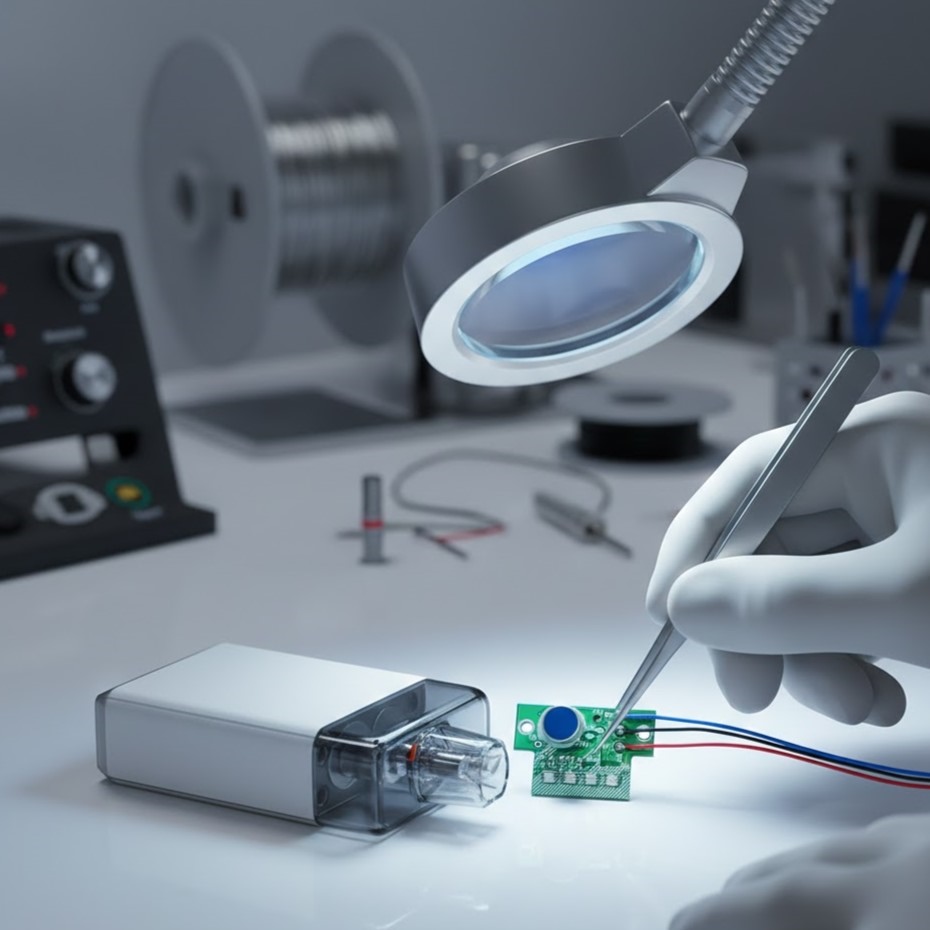
In the early days of the pod-style e-cigarette circuit modules’ industry, the “brain” of a device was often a borrowed one. Manufacturers relied on general-purpose MCUs (Microcontroller Units)—the same chips found in small kitchen appliances or basic remote controls—to manage the delicate process of heating an e-liquid. While functional, these “General-Purpose Computing Units” were jacks-of-all-trades and masters of none. They were adapted to vaporization, but they were never born for it.
Today, we are witnessing a profound technological migration. The industry is moving away from generic logic toward ASIC (Application-Specific Integrated Circuit) design—chips engineered from the transistor level up for the sole purpose of atomization. This shift marks the evolution of pod-style e-cigarette circuit modules from a “computing board that can vaporize” into a dedicated, highly efficient “Sensory Processing Organ.” This article explores how dedicated chipsets are redefining performance, reliability, and the very sensory essence of the vaping experience.
1. The Limitations of the “Generalist”: Why MCUs Are No Longer Enough
In the pursuit of a perfect puff, milliseconds and millivolts matter. General-purpose MCUs are designed to handle a wide variety of tasks—calculating logic, managing displays, and processing diverse inputs. However, this versatility comes at a cost: Redundancy.
The Efficiency Gap
A general-purpose chip carries a heavy architectural “overhead.” Much of its silicon area and power consumption is dedicated to functions that a vaporization device will never use. When a chip is trying to be “everything to everyone,” it cannot be “perfect for one thing.”
-
Latency: In an MCU, the command to “fire” must travel through layers of generic software abstraction. This creates a perceptible delay between the user’s puff and the actual heating.
-
Power Waste: Generic chips lack the specialized power-saving states required for the compact batteries found in modern pod systems, leading to shorter lifespans and more frequent charging.
2. The ASIC Revolution: Engineering the “Sensory Organ.”
When a circuit is designed as an ASIC, it is no longer a general-purpose computer; it is a physical manifestation of an atomization algorithm. It doesn’t “calculate” how to vaporize; it is built to vaporize.
Precision Temperature Control (The Sense of Touch)
For a “Sensory Organ,” maintaining the exact temperature of the coil is equivalent to a human’s sense of touch.
-
Hardware-Level Algorithms: Instead of running complex software loops to guess the temperature, dedicated chipsets integrate specialized ADC (Analog-to-Digital Converter) channels and hardware logic that monitor the resistance change of the coil in real-time.
-
Dry-Hit Prevention: By acting as a “sensory processor,” the chip can detect a dry coil and cut power within microseconds—far faster than any software-based MCU could react.
Instantaneous Response (The Sense of Reflex)
The evolution of pod-style e-cigarette circuit modules toward dedicated silicon allows for “Zero-Latency” firing.
-
Dedicated Power Paths: The path from the pressure sensor to the power MOSFET is streamlined. In an ASIC, this is a dedicated hardware trigger, reducing ramp-up time to near-instant levels (often less than 0.001 seconds). This ensures that the first milligram of vapor is just as flavorful as the last.
3. The “Focused” Advantage: Compactness and Reliability
By stripping away the “junk” of general computing, dedicated chipsets achieve a level of physical and operational optimization that was previously impossible.
Miniaturization of the Pod Form Factor
Space is the most expensive commodity in a pod system.
-
Reduced Footprint: Because an ASIC only contains the circuits it needs, it can be significantly smaller than a generic MCU. This allows for more space for e-liquid capacity or a larger battery within the same device dimensions.
-
Integration: Dedicated chips often integrate the power management (charging), the protection logic, and the firing control into a single “System-on-Chip” (SoC). Fewer components on the PCBA mean fewer points of failure.
Hardware-Level Immunity
Software-based systems are prone to “glitches” or “freezing” due to memory overflows or code errors. A “Focused Sensory Organ” operates on hard-coded logic.
-
Physical Protection: Over-charge, short-circuit, and over-time protection are not “decisions” made by software; they are physical gates within the silicon. This creates an unshakeable “Firewall” that protects the user even if the device is dropped or exposed to moisture.
4. Why “Dedicated” Wins the Market
For brands and manufacturers, choosing pod-style e-cigarette circuit modules powered by dedicated chipsets is a transition from selling a “gadget” to providing a “professional sensory tool.”
-
Consistency as a Brand Identity: In the vaping world, the most successful brands are those whose flavor delivery is identical every single time. Dedicated chips eliminate the “voltage sag” and “temperature drift” common in cheaper generic boards, ensuring a consistent brand experience.
-
Extended Battery Longevity: By optimizing every micro-ampere of current, ASIC-based modules can extend battery life by up to 20% compared to generic MCUs. This is a massive selling point for the “on-the-go” user.
-
Future-Proofing for Regulation: As global standards for e-cigarettes become stricter regarding temperature limits and safety certifications, hardware-level precision will be the only way to ensure compliance without compromising performance.
5. Conclusion: The Arrival of the Professional Era
The era of “adapting” generic electronics for vaporization is coming to a close. The future belongs to the pod-style e-cigarette circuit modules that are “Born for Vaporization.”
By evolving the circuit from a “General Computing Unit” into a “Focused Sensory Organ,” we are doing more than just improving specs. We are creating devices that truly “understand” the physical process of atomization. They “feel” the temperature, “react” to the airflow, and “protect” the user with an efficiency that generic hardware can never replicate. In this square inch of silicon, the transition from an amateur toy to a professional-grade sensory instrument is complete. Performance and reliability have found their new home in the dedicated chipset.