

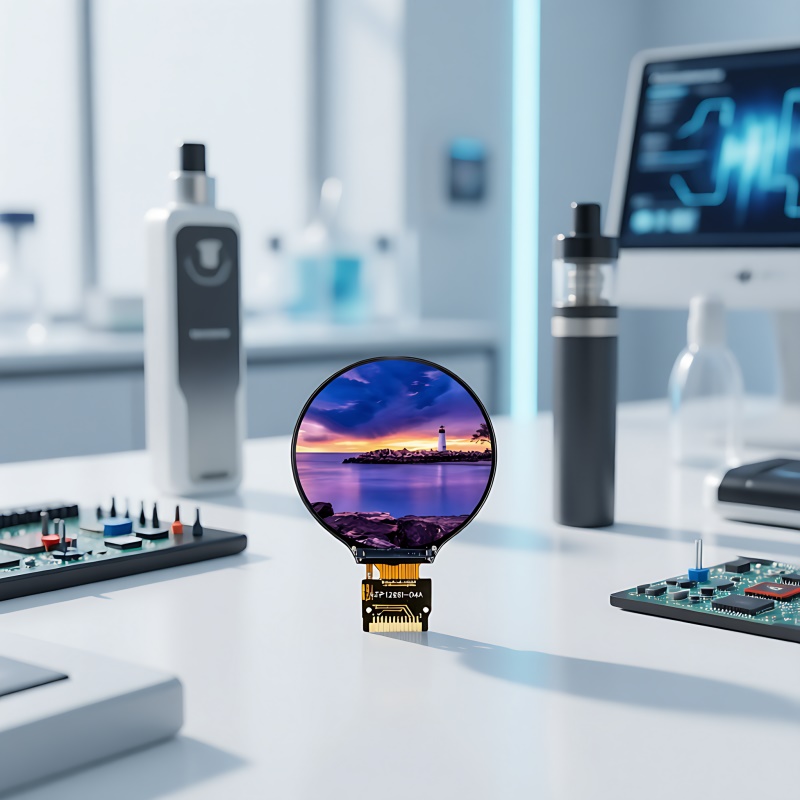
Compact electronic devices require display solutions that balance visual performance, power efficiency, and available installation space. As device structures become increasingly compact, a circular screen can provide greater flexibility for product designers while maintaining clear visual feedback. The round TFT vape display combines a circular viewing area with high brightness, low power consumption, fast refresh performance, and a compact PCB structure. Therefore, it can support battery visualization and interface functions while fitting into space-conscious electronic product designs.
Circular Design for Compact Device Integration
A circular display can create new possibilities for product layouts that do not rely on traditional rectangular screen structures. The 1.28-inch TFT display module provides a round viewing area of 32.4 × 32.4 mm, while the panel size is 35.6 × 38.1 × 1.6 mm. As a result, designers can position the display within compact device housings while maintaining a distinctive visual interface. Moreover, the 1.5 mm module thickness helps support slim internal structures where installation space is limited. The display is designed for modern PCBA integration and can present battery percentage, voltage, working status, icons, and other interface information. Its circular format also allows manufacturers to create visual interfaces that match the shape and appearance of specific products. Furthermore, the compact structure leaves more flexibility for arranging batteries, control components, and other electronic parts around the display.
High-Brightness Display with Efficient Power Use
Display performance is important when a small screen needs to communicate several types of information clearly. This module provides a brightness of 350 cd/m², helping improve visual clarity under different lighting conditions. Meanwhile, its low-power design supports efficient operation in compact battery-powered electronics. In addition, the fast refresh performance allows information such as battery levels and status indicators to update responsively.
The combination of brightness and power efficiency gives manufacturers greater flexibility when planning the overall product architecture. Instead of using a larger screen to achieve sufficient visibility, designers can use a compact display while keeping the interface visually clear. Consequently, the display can provide useful real-time feedback without taking up unnecessary internal space.
Key Design Benefits
- Circular display structure for distinctive and space-conscious product layouts
- 350 cd/m² brightness for clear visual output
- 240RGB × 240 pixels for detailed color visualization
- Low-power design for compact battery-powered electronics
- Fast refresh performance for responsive interface updates
- 1.5 mm module thickness for slim product structures
- Compact PCB construction for flexible PCBA integration
240RGB × 240 Resolution for Detailed Visual Interfaces
The module uses a 240RGB × 240 pixel configuration, providing a balanced combination of resolution and compact screen size. This resolution allows manufacturers to display battery indicators, icons, status information, and other interface elements with clear visual definition. Moreover, the GC9A01 display IC supports the module’s display architecture and provides a practical foundation for customized interface development.
The white display configuration can also work with different UI concepts and visual styles. Designers can organize icons, indicators, and battery information according to the overall product interface. Therefore, the round TFT vape display can be used not only for basic battery feedback but also as part of a more customized visual interface.
4-SPI/MCU Interface Enables Efficient Display Integration
The module uses a 4-SPI/MCU interface for communication with the main control unit. This interface provides a practical connection method for compact electronic designs and supports stable data transmission between the display and control circuitry. In addition, the flexible interface configuration allows engineers to consider the display during the early stages of PCBA development. As a result, the screen can be integrated more efficiently with other electronic components.
The driving voltage is 2.5–3.3V, while the backlight voltage is 3.0V. These specifications give engineers clear electrical parameters when planning the display within the overall circuit architecture. Furthermore, understanding the interface and voltage requirements early can help reduce unnecessary changes during PCB and firmware development.
| Technical Parameter | Specification |
|---|---|
| Product Type | 1.28-inch TFT E-Cigarette Battery Display Board |
| Model | N128-2424THWIG04 |
| Resolution | 96 × 54 |
| Number of Pixels | 240RGB × 240 |
| Visible Area | 32.4 × 32.4 mm |
| Panel Size | 35.6 × 38.1 × 1.6 mm |
| Display Colour | White |
| IC | GC9A01 |
| Module Thickness | 1.5 mm |
| Driving Voltage | 2.5–3.3V |
| Backlight Type | Glue-Iron Integrated |
| Backlight Voltage | 3.0V |
| Brightness | 350 cd/m² |
| Operating Temperature | -20°C to 70°C |
| Storage Temperature | -30°C to 80°C |
| Interface | 4-SPI/MCU |
Custom UI and Battery Visualization
A display module becomes more useful when its interface can be adapted to the requirements of different products. This solution supports custom UI elements such as battery indicators, consumption bars, status icons, and battery alerts. Manufacturers can therefore create an interface that matches their product structure and control logic instead of relying on a fixed display layout. Moreover, customized visual elements can help maintain a consistent interface across different product configurations. The round TFT vape display is particularly suitable for projects that require a compact visual interface with customized information. Engineers can coordinate screen content with the main control board and develop display functions according to specific project requirements. Meanwhile, the compact circular structure provides greater freedom when creating product-specific enclosure and PCB layouts.
OEM and ODM Support for Customized Projects
Different manufacturers may have different requirements for display dimensions, interfaces, UI layouts, and electronic integration. For this reason, OEM and ODM support can simplify the transition from an initial product concept to a production-ready display solution. RIMYI provides engineering support for customized display projects, including display firmware, pin headers, UI elements, and other project-specific requirements. Consequently, manufacturers can develop a display solution around their existing hardware architecture rather than adapting the entire product to a standard module.
Customization can also be considered during the early product development stage. Engineers can evaluate the display size, PCB structure, interface, voltage requirements, and UI concept together before finalizing the device design. This approach can improve coordination between the display module and the rest of the PCBA while reducing unnecessary redesign work.
Reliable Performance for Compact Electronics
The module is designed for long-term display operation and provides clear visual output under variable lighting conditions. Its solid PCB construction supports stable installation within compact enclosures, while the slim structure helps maintain efficient internal space utilization. The operating temperature range of -20°C to 70°C and storage temperature range of -30°C to 80°C provide defined conditions for engineering evaluation. Therefore, manufacturers can assess the display according to their specific product environment and integration requirements.
Overall, the circular form factor, 240RGB × 240 resolution, GC9A01 IC, 4-SPI/MCU interface, 350 cd/m² brightness, and compact construction create a flexible foundation for customized electronic products. Combined with custom UI capabilities and OEM/ODM engineering support, the module can help manufacturers integrate clear visual feedback into compact product architectures. The round TFT vape display offers a practical approach for projects where display performance, compact integration, and interface customization need to work together.