

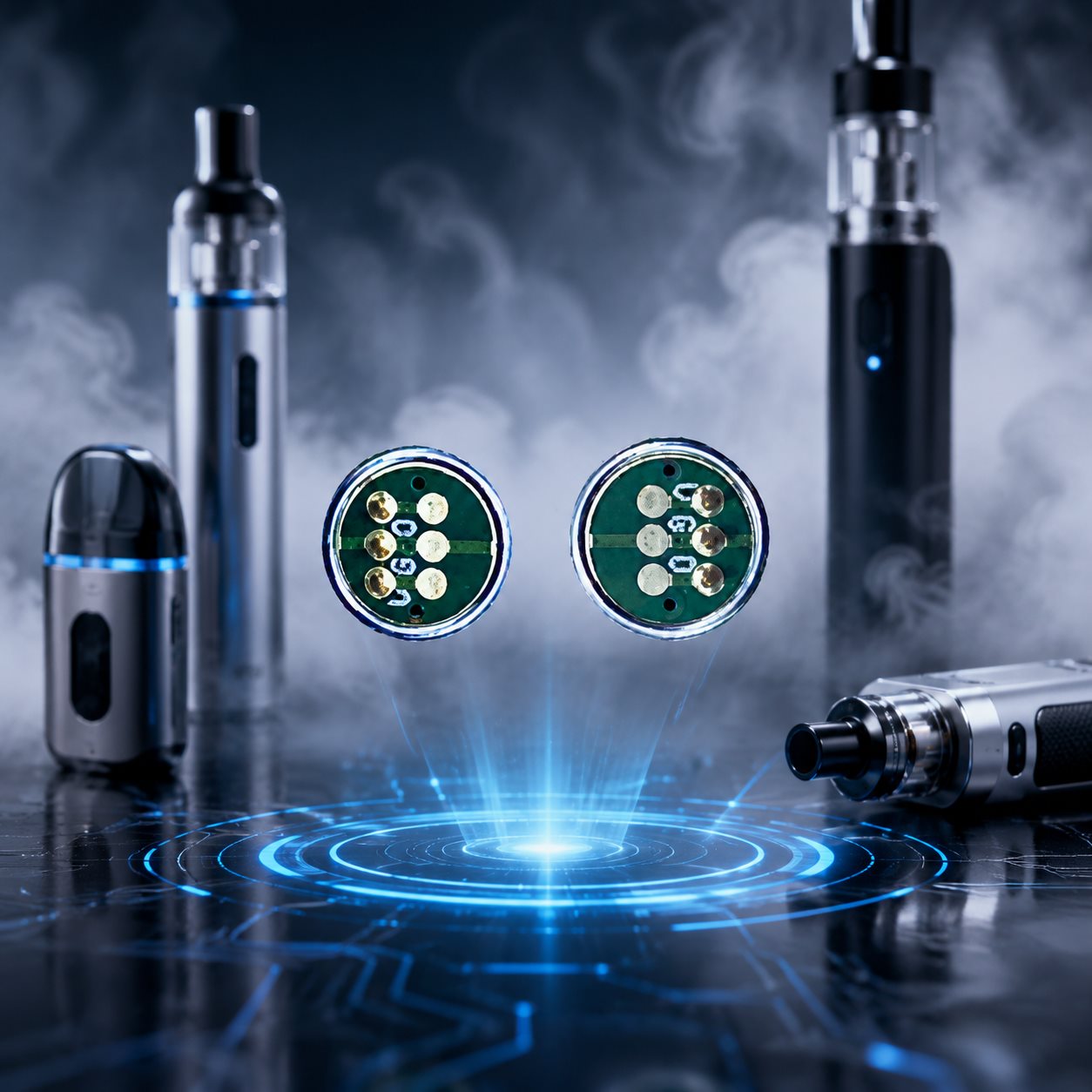
In modern compact vaping devices, unstable activation under weak inhalation conditions creates a major engineering challenge. However, when airflow pressure drops too low, devices fail to trigger or respond inconsistently, which reduces user experience and system reliability. This issue often appears in miniaturized PCBA structures where engineers must balance airflow sensitivity with contamination resistance. The airflow control vape sensor detects subtle pressure changes and converts them into activation signals. However, under low suction conditions, signal instability, delayed triggering, or complete failure can occur because airflow energy becomes insufficient or structurally distorted. Therefore, engineers must optimize both hardware architecture and sensing logic to improve system performance.
1. Root Causes of Light Suction Failure in Airflow Systems
Light suction failure comes from multiple interacting design factors instead of a single defect. In most cases, engineers identify several core issues in airflow-based vape systems.
- Airflow pressure remains too weak for stable detection
- Poor structural alignment creates turbulence inside channels
- Condensation or residue accumulates inside the sensing chamber
- Over-filtered airflow reduces effective signal strength
- PCB signal processing introduces delay or noise interference
Furthermore, when engineers do not calibrate sensitivity correctly, the airflow control vape sensor misinterprets weak airflow signals as noise. As a result, this leads to missed activation or unstable response.
2. System-Level Troubleshooting Framework
Engineers use a structured diagnostic model to analyze unstable activation problems. Meanwhile, they evaluate multiple performance layers to locate bottlenecks efficiently.
Airflow Control Failure Analysis Table
| Failure Mode | Root Cause | System Impact | Optimization Strategy |
|---|---|---|---|
| Weak Trigger Response | Low airflow pressure | Delayed activation | Increase sensitivity calibration |
| No Activation | Blocked airflow channel | System failure | Redesign the airflow path |
| False Triggering | Signal noise interference | Unstable output | Improve the filtering algorithm |
| Drift Over Time | Condensation buildup | Accuracy loss | Strengthen sealing design |
Thus, this structured method helps engineers quickly locate issues in the airflow control vape sensor system. In addition, it allows targeted performance optimization instead of trial-and-error debugging.
3. Structural Optimization of Airflow Detection Module
To improve light suction sensitivity, engineers redesign the airflow path structure. Firstly, they reduce airflow resistance by optimizing inlet geometry. Secondly, they improve channel alignment to stabilize airflow direction. Furthermore, engineers reshape the internal sensing chamber to minimize turbulence and improve pressure transmission efficiency. As a result, even weak inhalation can generate enough pressure change for accurate detection. In RIMYI engineering development, teams simulate airflow behavior before production. Therefore, it achieves stable sensitivity across different device layouts.
4. Signal Processing and Sensitivity Enhancement
Engineers also improve electronic signal processing to solve activation instability issues. At the same time, they refine both hardware and firmware layers.
Key improvements include:
- Strengthening low-pressure signal amplification
- Filtering micro airflow noise signals
- Increasing ADC sampling speed
- Adjusting adaptive trigger thresholds
In addition, firmware optimization allows the system to recognize weak airflow signals without increasing false activation risk. Consequently, this balance improves overall system stability in compact vape devices.
5. Integrated PCB and Sensor Coordination Strategy
From a PCBA design perspective, engineers tightly coordinate airflow sensors with control circuits. Otherwise, signal delay or interference may occur.
The optimized system includes:
- High-sensitivity airflow sensor module
- Low-noise signal conditioning circuit
- Fast-response MCU processing unit
- Stable power management system
When properly integrated, the airflow control vape sensor delivers faster response and more stable activation. Moreover, it maintains consistent performance even under weak suction conditions.
6. Manufacturing Stability and RIMYI Engineering Approach
During mass production, small assembly variations can affect airflow sensitivity. Therefore, engineers enforce strict quality control across structural alignment and calibration processes. At RIMYI, engineers test every module through airflow consistency checks, sensitivity validation, and long-term activation simulation. As a result, each airflow control vape sensor maintains uniform performance across production batches. Furthermore, RIMYI continuously improves PCBA layout and airflow design. In this way, failure rates decrease significantly in real-world applications, especially in compact disposable and refillable vape systems.
Conclusion
Unstable activation under light suction conditions results from combined issues in airflow structure, sensor sensitivity, and electronic processing. However, when engineers apply systematic troubleshooting and structural optimization, system performance improves significantly.
Through refined airflow design and signal enhancement, the airflow control vape sensor achieves higher sensitivity, faster response, and stronger stability. Ultimately, RIMYI continues to optimize PCBA integration and airflow architecture to support reliable performance in next-generation vape device applications.
