

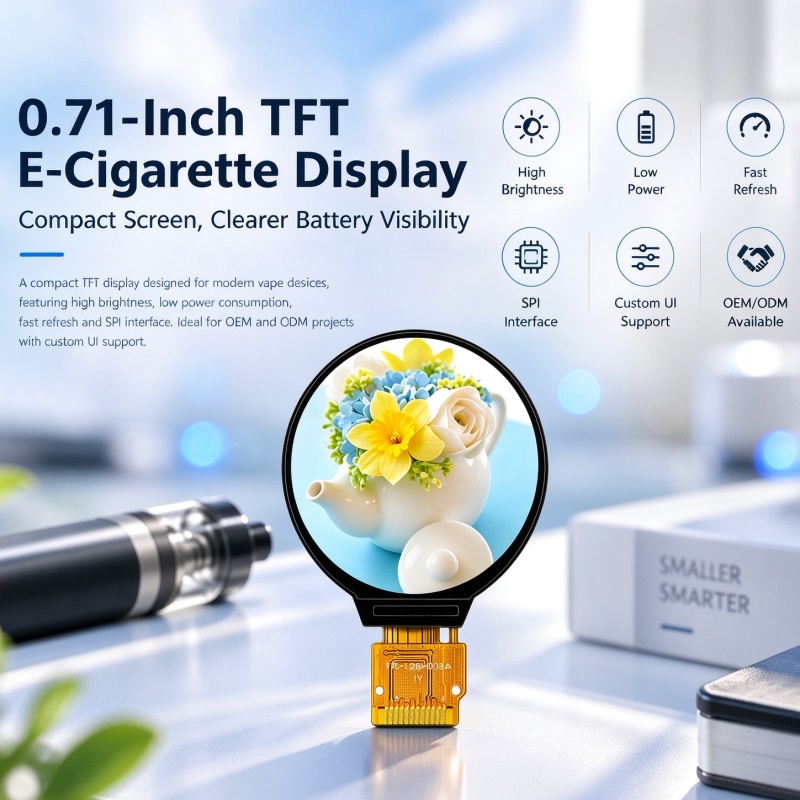
As electronic devices become smaller and more feature-rich, clear battery feedback has become an important part of compact device design. A display must provide useful information while taking up very little space and consuming limited power. Therefore, the 0.71-inch TFT e-cigarette display combines a compact form factor with color visualization, high brightness, low power consumption, and fast refresh performance. This design makes it easier for manufacturers to integrate real-time battery information into compact electronic devices without compromising the available PCB space.
Compact Display Design for Real-Time Battery Visibility
The e-cigarette battery display board uses a 0.71-inch TFT color screen designed to provide clear visual feedback in a compact footprint. Its high-brightness display helps users view battery percentage, voltage, working status, and other interface information, while the fast refresh rate supports responsive screen updates. Moreover, the low-power design helps limit the display’s impact on the overall power budget of the device. As a result, manufacturers can integrate useful visual feedback into smaller product structures while maintaining a practical balance between display performance and space efficiency.
The compact PCB structure is particularly useful when internal space is limited. Instead of relying on a larger display module, designers can incorporate a small TFT solution directly into the device architecture. This approach provides greater flexibility when arranging the battery, control board, interface components, and other internal elements. Consequently, the display can become an integrated part of the overall product design rather than an additional component that requires excessive installation space.
High Brightness and Fast Refresh for Clear Information
Display clarity is important when a small screen needs to communicate several types of information within a limited viewing area. The TFT color screen provides high brightness and clear visual output, making battery indicators, icons, and status information easier to distinguish under different lighting conditions. Furthermore, the fast refresh capability supports smooth updates when displayed information changes. These characteristics allow the screen to deliver a more responsive interface without requiring a larger display footprint.
For compact electronic devices, display performance needs to work alongside power efficiency. A screen that consumes excessive power may affect the overall design objectives of a battery-powered product, especially when space for the battery is also limited. Therefore, the combination of low power consumption, high brightness, and fast refresh provides a practical foundation for compact display integration. The following features summarize the main design considerations:
- Compact 0.71-inch TFT color screen for space-limited product structures
- High-brightness display for clearer visual information
- Low-power operation to support efficient device design
- Fast refresh performance for responsive screen updates
- SPI interface for stable communication with the main control unit
- Custom UI and icons for application-specific interfaces
- Battery alerts and indicators for clearer device status feedback
SPI Interface Supports Flexible PCB Integration
The module uses an SPI interface for stable data transmission between the display and the main control unit. This interface allows designers to coordinate screen information with the device’s control logic while maintaining a compact internal structure. In addition, the flexible PCB design makes the module suitable for different board layouts and compact electronic architectures. As a result, manufacturers can integrate the display into customized hardware designs without making the screen the limiting factor in overall PCB planning.
The SPI connection also provides a practical foundation for customized interface development. Depending on the product architecture, manufacturers can configure visual elements such as icons, battery indicators, status information, and warning alerts. This flexibility is especially useful for OEM and ODM projects where the user interface needs to match a specific product structure or brand requirement. Meanwhile, a compact display module can simplify the process of developing a consistent visual interface across different device configurations.
Custom UI and OEM/ODM Integration
Customization is another important consideration for manufacturers developing compact electronic products. The display board supports customized UI elements, icons, and battery alerts, allowing the interface to be adapted to different hardware requirements. RIMYI can support OEM and ODM projects that require display integration, customized firmware-related functions, pin configurations, or other project-specific requirements. Therefore, manufacturers can work with a display solution that fits both the physical structure and interface design of their products.
| Feature | Design Value |
|---|---|
| 0.71-inch TFT color screen | Provides compact color visualization |
| High brightness | Improves visibility under variable lighting |
| Low power consumption | Supports efficient battery-powered designs |
| Fast refresh | Enables responsive screen updates |
| SPI interface | Provides stable data transmission |
| Compact PCB | Supports integration into limited spaces |
| Custom UI and icons | Enables application-specific interfaces |
| Battery alerts | Provides clearer device status feedback |
| OEM/ODM support | Allows project-specific customization |
Reliable Display Performance in Compact Devices
A display module must remain stable after being integrated into a small enclosure. The slim structure and solid PCB backing help support stable installation where internal space is restricted. Moreover, the module is designed for long-term operation with clear display performance under variable lighting conditions. These characteristics make it suitable for manufacturers seeking a compact visual interface that can remain consistent throughout regular device operation. Because every product architecture has different internal constraints, display integration should be considered during the early design stage. Engineers can evaluate the available PCB space, interface requirements, screen layout, and desired UI functions before finalizing the hardware structure. This approach can reduce unnecessary redesign work and make the integration process more efficient. In addition, early planning provides more opportunities to coordinate the display with the battery, control board, and enclosure.
Supporting Smarter Compact Product Development
The 0.71-inch TFT e-cigarette display offers a practical combination of compact dimensions, color visualization, high brightness, low power consumption, fast refresh, and SPI connectivity. More importantly, its customizable UI and battery alert functions allow manufacturers to create interfaces that match specific product requirements. These capabilities make the module suitable for compact electronic product development where available space, power efficiency, and clear information display must work together.
Overall, a small display does not need to sacrifice useful functionality. By combining a compact TFT structure with flexible interface support and customizable visual elements, manufacturers can improve battery visibility while maintaining efficient internal product layouts. With OEM and ODM support, RIMYI can provide a display solution that can be adapted to different hardware architectures, interface requirements, and product development projects.