

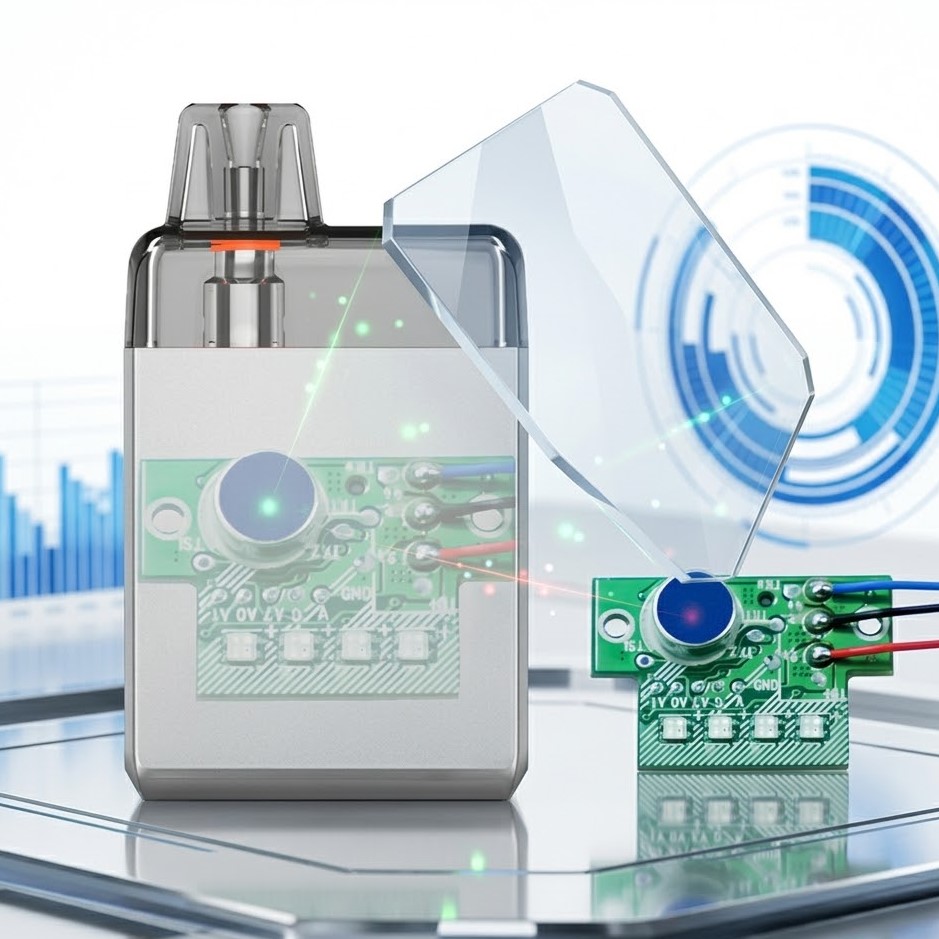
The rapid evolution of open and closed pod systems has made user experience (UX) the ultimate battleground for brand loyalty. In early-generation vape hardware, a capsule’s performance relied almost entirely on the heating coil or the battery capacity. Today, however, the defining metric of a premium device is its activation consistency—how instantly and reliably it fires the moment a user takes a draw.
For years, the industry relied on traditional electret condenser microphones (ECMs) modified to act as pneumatic switches. However, as devices become more compact and e-liquid formulations change, these traditional sensors are hitting a mechanical wall, leading to notorious defects like “auto-firing” or complete activation failure.
To solve this, advanced hardware architectures are pivoting to surface-mount MEMS (Micro-Electro-Mechanical Systems) airflow sensors. This guide explores why a 3-wire microphone vape PCB embedded with MEMS technology is essential for next-generation pod manufacturing.
1. The Architectural Showdown: Traditional ECM vs. Solid-State MEMS
To appreciate the stability of a 3-wire microphone vape PCB utilizing MEMS, we must look at the underlying mechanical differences between the old and new sensor eras.
 Traditional Electret (ECM)                   Solid-State MEMS Sensor
   [Flexible Membrane]                          [Silicon Substrate]
           │ (Prone to moisture warping)                 │ (Micro-machined cavity)
   [Mechanical Contact]                         [Capacitive ASIC Bridge]
Traditional Modified ECMs: The Mechanical Vulnerability
Traditional vape microphones use a thin, flexible electret membrane suspended over a backplate. When a user draws air through the pod, the negative pressure deflects this membrane, completing a circuit and signaling the MCU to fire.
-
The Moisture Trap: Because these sensors rely on physical airspace inside the chamber, they are highly vulnerable to condensation, condensation-heavy aerosol backflow, and direct e-liquid leaks. Once liquid penetrates the membrane, the surface tension glues the components together, causing the device to either freeze permanently or enter a dangerous “auto-fire” loop.
-
Structural Drift: Over months of use, environmental temperature swings and repeated physical drops stretch the electret membrane, permanently altering its tension and degrading its firing sensitivity.
MEMS Airflow Sensors: The Solid-State Revolution
MEMS airflow sensors replace loose mechanical membranes with a micro-machined silicon diaphragm etched directly into an integrated circuit chip (ASIC).
-
Capacitive Detection: Instead of relying on a crude physical touchpoint, the MEMS sensor measures microscopic changes in capacitance across a sealed silicon bridge as air pressure fluctuates.
-
Environmental Isolation: The internal architecture of MEMS airflow sensors is naturally highly resistant to oil, moisture, and chemical corrosion. Even if e-liquid enters the airflow pathway, the solid-state silicon element resists warping, ensuring long-term structural integrity.
2. Decoding the Parameter: The -150 ± 50Pa Sweet Spot
The core performance of a MEMS-driven 3-wire microphone vape PCB is governed by its native negative pressure activation threshold. For premium pod systems, the industry standard has settled on an optimized parameter of -150 ± 50Pa.
  [0 Pa] ───────────────────────────────> Ambient State (Resting)
  [-100 Pa] ──> Anti-False Trigger Zone  (Wind resistance / Pocket movement)
  [-150 Pa] ──> CRITICAL TRIGGER POINT   (Instant firing threshold)
  [-200 Pa] ──> Maximum Effort Bound     (Firm draw activation)
This specific threshold acts as a balance between ease of use and safety mitigation:
-
Preventing “Dead Draws” (The -100Pa Floor): If the activation threshold is set too high, light vapers or those using open-airflow pods will experience a “dead draw”—they inhale, but the coil fails to heat. A threshold that remains responsive down to -100Pa ensures instant ignition with minimal physical effort.
-
Eliminating False Fires (The -200Pa): Conversely, if a sensor is hyper-sensitive (triggering at -50\Pa), simple environmental variables like a gust of wind, ambient noise vibrations, or placing the device inside a tight pocket can accidentally trigger the pressure bridge.
-
The SMT Stability Buffer: Because MEMS sensors are manufactured using automated semiconductor lines, their variance can be tightly controlled within a narrow pm50Pa envelope. Traditional hand-soldered components can drift by more than pm120Pa, meaning half of a production batch could easily end up either too stiff or dangerously over-sensitive.
3. DFM (Design for Manufacturing) Insights for MEMS PCBA Layout
Migrating your hardware architecture to a 3-wire microphone vape PCB layout powered by MEMS requires strict adherence to specialized DFM rules during the board layout and reflow assembly phases.
-
Acoustic/Pneumatic Chamber Design: Unlike traditional microphones that can be placed loosely inside the housing, a MEMS airflow sensor requires a dedicated, isolated airflow channel molded into the device body. The inlet port on the PCBA must align perfectly with the rubber gasket or silicone boot to ensure that ambient internal air pressure doesn’t skew the capacitive readings.
-
Reflow Heat Profiles: MEMS components feature an open acoustic/pneumatic entry port on their metallic housings. During the surface-mount technology (SMT) reflow process, strict care must be taken to prevent solder paste outgassing or volatile flux vapors from drifting into the sensor port, which could coat the micro-machined silicon diaphragm.
-
3-Wire Circuit Redundancy: By utilizing a dedicated 3-wire setup (VCC, GND, and OUT), the sensor maintains a constant, stable reference voltage from the power management IC. This setup minimizes signal noise and prevents voltage sags from causing erratic firing behavior when the battery drops below 3.5V.
Technical Selection Blueprint
| Operational Criteria | Traditional Modified ECM | 3-Wire MEMS Airflow PCB (RIMYI) |
| Sensor Architecture | Mechanical Electret Film | Solid-State Silicon Cap Array |
| Moisture / E-Liquid Leak Defect Rate | High (Prone to sticking/auto-firing) | Ultra-Low (Corrosion-resistant ASIC) |
| Tolerance Consistency | High variance (±120Pa) | Tight, repeatable bounds (±50Pa) |
| Assembly Method | Manual hand-soldering or wire leading | Fully automated SMT reflow |
| Device Lifespan | Degrades over time due to spring fatigue | Stable performance over millions of cycles |
Conclusion: Standardizing on Zero-Defect UX
In the competitive global pod market, device failures destroy brand loyalty instantly. Defective hardware that auto-fires or fails to activate ruins consumer trust.
Stop risking your market reputation on legacy, moisture-sensitive electret components. These outdated parts consistently struggle with performance stability. Instead, transition your product portfolio to the precision of a 3-wire microphone vape PCB.
By embedding advanced solid-state MEMS technology, you protect your hardware from internal moisture damage. Consequently, your automated assembly lines will achieve significantly higher production yields. Furthermore, product return rates will plummet rapidly.
Most importantly, your end-users will enjoy a flawless, ultra-responsive vaping experience. This modern engineering choice guarantees absolute satisfaction from the very first drawing to the last.
Contact RIMYI’s engineering team today to customize a high-performance PCBA solution tailored to your device specifications.