

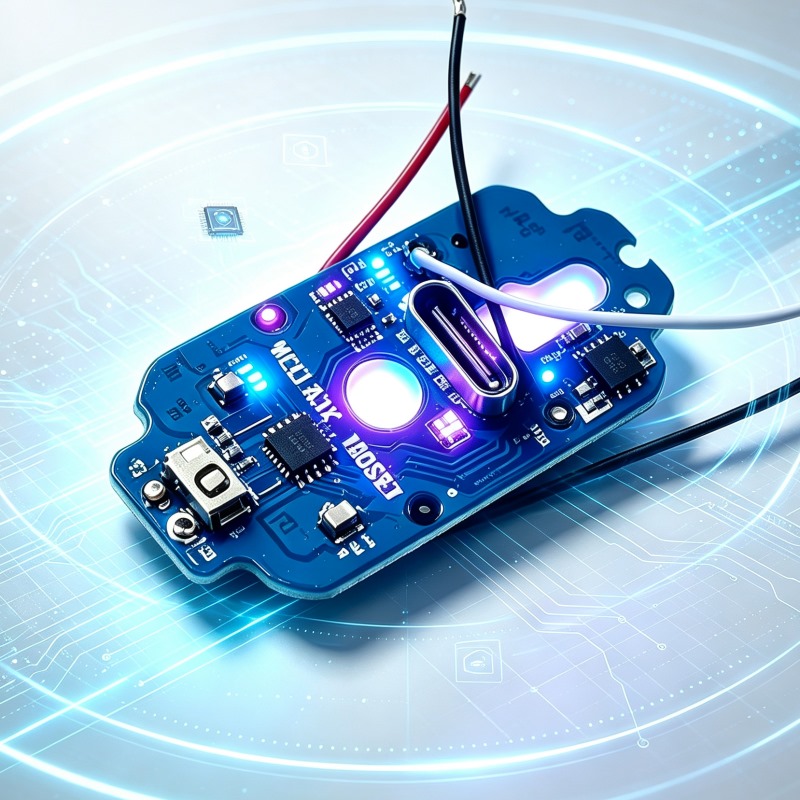
A reliable control board plays an important role in the overall performance and protection of a pod system. As electronic devices become more compact and feature-rich, the PCB needs to manage power output, charging, temperature, airflow signals, and abnormal operating conditions within a limited space. A multi-mode vape PCB with protection integrates these functions into one control platform, helping manufacturers create more stable and reliable pod system designs.
Why Protection Functions Matter in Vape PCBs
A control board does more than regulate voltage. It also monitors electrical and operating conditions to help protect the device and its internal components. Therefore, manufacturers need to consider multiple protection mechanisms when developing a pod system. The customized vape control board from RIMYI combines output control, LED feedback, charging management, and multiple protection functions. Moreover, its control logic is designed to provide clear responses to different operating conditions. As a result, the PCB can support a more structured approach to device protection and performance management.
Seven Protection Features for a More Reliable Control System
A well-designed PCB should respond appropriately when abnormal conditions occur. This board integrates seven protection functions that cover common electrical and operational risks:
- Timeout protection: Helps limit continuous operation beyond the configured period.
- Low-voltage protection: Helps prevent operation when battery voltage reaches an unsafe level.
- Short-circuit protection: Responds when an abnormal electrical connection is detected.
- Open-circuit protection: Identifies conditions where the expected circuit connection is interrupted.
- Overtemperature protection: Helps control operation when internal temperature rises excessively.
- Airflow error protection: Monitors airflow-related conditions and responds to abnormal signals.
- Reverse-flow protection: Provides an additional layer of control against detected reverse airflow conditions.
Together, these functions allow the control board to monitor different aspects of device operation. Furthermore, LED indicators can communicate fault conditions through different visual signals, making system status easier to identify during testing and operation.
Multi-Mode Output for Flexible Power Management
Output control is another important feature of a modern pod system PCB. The board supports three voltage modes at 3.2V, 3.6V, and 3.9V, with blue, purple, and white LED indicators corresponding to each mode. Users can cycle between the available modes through the configured button operation. In addition, the board provides a 10-second preheat function at 2.2V through a triple-click operation. This control logic gives manufacturers greater flexibility when developing different device configurations. Consequently, the PCB can support products that require multiple predefined output settings rather than a single fixed output.
LED Feedback Simplifies Device Status Monitoring
Visual feedback can make compact electronic systems easier to understand. Instead of relying on complex displays, the control board uses multi-color LED signals to communicate operating modes, battery status, power events, and error conditions. For example, different colors can identify selected voltage modes, while specific flashing patterns can indicate protection events. Therefore, the LED system provides an efficient interface between the control logic and the external device design. This approach is particularly useful for compact pod systems where available space limits the use of larger displays.
Pressure-Sensitive Airflow Detection
Airflow detection is another important part of the control system. With an airflow sensitivity of –300Pa, the board can detect draw-related pressure changes and use this information as part of its operating logic. Moreover, the board provides several control methods through a single button. Five clicks can control power on or off, while a long press can activate manual operation according to the configured firmware logic. As a result, manufacturers can simplify the external interface while retaining multiple control functions.
Efficient Type-C Charging Management
Charging performance directly affects the reliability of a battery-powered electronic device. This PCB uses a gold-plated Type-C port and supports 400mA charging, providing a standardized charging interface for compatible device designs. Furthermore, the board includes overvoltage protection at 28V to help protect internal components against excessive input voltage. The USB connection is also designed to withstand more than 1,000 connection cycles. Therefore, the charging section can support repeated everyday operation while adding another layer of electrical protection.
Protection and Control Specifications
| Feature | Specification | Design Benefit |
|---|---|---|
| Voltage Modes | 3.2V / 3.6V / 3.9V | Supports multiple output configurations |
| Preheat | 2.2V for 10 seconds | Provides an additional controlled mode |
| Airflow Sensitivity | -300Pa | Supports draw detection |
| Charging Current | 400mA | Provides controlled charging |
| Overvoltage Protection | 28V | Helps protect charging components |
| Protection Functions | 7 | Covers multiple abnormal conditions |
| LED Feedback | Multi-color | Provides clear status indication |
| USB Durability | Over 1,000 cycles | Supports repeated connection use |
| Temperature Testing | -15°C to 45°C | Validates operation across temperature conditions |
| Discharge Validation | 6A | Supports stress testing and reliability evaluation |
Custom Firmware and Hardware Options
Different pod system designs can require different control parameters. For this reason, a multi-mode vape PCB with protection should offer more than fixed hardware functions. This board supports customization of key components such as the MCU, charging IC, and MOSFET. In addition, manufacturers can adjust voltage curves, LED patterns, protection thresholds, and button sensitivity according to their device specifications. Therefore, the same basic PCB platform can be adapted to different product architectures and control requirements.
Testing for Stability and Durability
Electronic components need to perform consistently under different environmental and operating conditions. The board has undergone extreme temperature testing from -15°C to 45°C, while 6A discharge stress validation helps evaluate its performance under higher current conditions. Moreover, these tests provide manufacturers with useful information when assessing PCB reliability during product development. By combining electrical protection with environmental and stress validation, the control board can offer a more dependable foundation for compatible device designs.
Why Choose a Multi-Mode Control Platform?
A multi-mode vape PCB with protection brings several control functions together instead of relying on separate circuits for every feature. Voltage regulation, LED feedback, airflow detection, charging management, and protection logic can operate as part of one integrated system. As a result, manufacturers can simplify the overall electronic architecture while maintaining multiple operating and protection functions. Furthermore, configurable hardware and firmware options allow the PCB to adapt to different device requirements without completely redesigning the control platform.
A Flexible PCB Solution for Product Development
RIMYI focuses on customized control board solutions that combine functional integration with practical protection features. By supporting MCU, charging IC, MOSFET, LED, voltage, and protection parameter customization, the board can be adapted to different pod system designs and electronic configurations. For product developers, the ability to customize control logic can also help improve product differentiation. Instead of using identical fixed settings across different models, manufacturers can define output behavior, LED feedback, button sensitivity, and protection thresholds according to their specific design requirements.
Building Safer and More Reliable Pod System Electronics
A control board is one of the key electronic components in a modern pod system, so its protection architecture deserves careful attention. The combination of seven protection functions, multi-mode voltage control, airflow detection, Type-C charging, LED feedback, and configurable hardware provides a comprehensive control platform. Ultimately, a multi-mode vape PCB with protection can help manufacturers integrate essential monitoring and protection functions into a compact electronic design. With flexible customization options and validation across different operating conditions, this type of PCB provides a practical foundation for developing reliable and differentiated pod system hardware.